Here’s the number that should change how you think about follow-up: direct mail response rates are running 9x higher than email-based follow-up, according to PostcardMania’s data from their newly launched SmartTouch Automated Mailers. Nine times. That’s not a rounding error – it’s a signal that the channel mix most ABM teams are running in 2026 is badly out of balance. If your ABM playbook still treats physical outreach as a novelty, you’re leaving response rates on the table.
Account-based marketing is, at its core, a resource allocation decision. You’re choosing to spend more time and budget on fewer accounts, betting that precision beats volume. That bet only pays off if you’ve correctly identified which accounts deserve the focus. Most B2B teams get this wrong – not because they don’t understand ABM in theory, but because they skip the hard work at the front end.
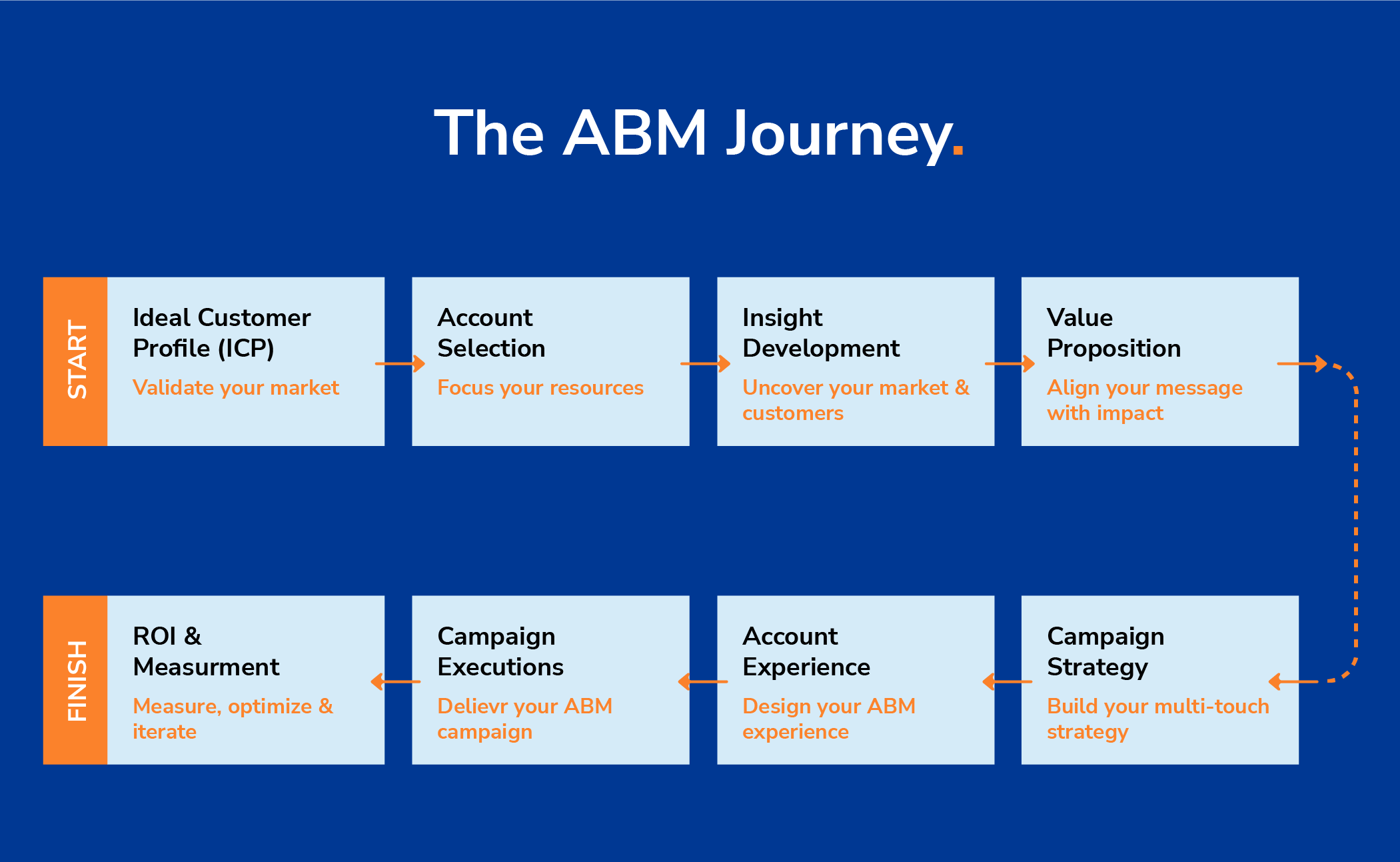
Step 1: Build an ICP That’s Actually Specific
Your Ideal Customer Profile (ICP) is the foundation everything else sits on. A vague ICP produces a vague target list, which produces disappointing results and a team that blames ABM instead of the setup. The goal here is specificity that feels almost uncomfortable.
Start with your closed-won data from the last 18-24 months. Look for patterns in firmographics – industry, headcount, revenue range, tech stack – but don’t stop there. Dig into the deal characteristics: which accounts closed fastest, which had the healthiest Customer Lifetime Value (LTV), which expanded most aggressively after the initial sale? The accounts that look good on paper at signing aren’t always the ones that matter most long-term.
A useful exercise is the negative ICP. Document the account characteristics that correlate with slow deals, high churn rate, and low expansion. Your sales team will recognize these patterns instantly, and getting them documented forces a clarity that “we want mid-market SaaS companies” simply doesn’t provide.
From there, tier your target accounts. Tier 1 accounts get the full treatment – custom content, direct outreach, multi-channel sequences including physical mail. Tier 2 gets a lighter version. Tier 3 can be handled with more automated, programmatic approaches. This tiering decision is really a Customer Acquisition Cost (CAC) management decision, and it should be treated as one.
Step 2: Build the Right Channel Mix (Email Isn’t Enough)
This is where the PostcardMania data matters. Most ABM programs are built around email sequences, LinkedIn ads, and the occasional sales call. That’s not wrong – but it’s incomplete. The accounts worth targeting are also the accounts getting the most email, and by now they’re largely immune to it.
A genuinely effective ABM channel mix in 2026 looks something like this:
- Personalized direct mail – triggered by CRM signals, not sent in bulk. Tools like SmartTouch use CRM data to fire physical mailers when a prospect hits a defined behavioral trigger. That personalization is what drives response.
- LinkedIn engagement – targeting the buying committee by job title, not just the primary contact. ABM is about accounts, not individuals.
- Personalized landing pages – one URL per account, with messaging that reflects their industry, pain points, and where they are in the sales cycle.
- SDR outreach – sequenced to follow other channel touches, not to lead them. Cold calls land differently when the prospect has already seen your name twice that week.
- Executive-to-executive outreach – especially for Tier 1 accounts. A short, specific note from your CEO to their CFO cuts through in a way that a sales email from an SDR never will.
Sequencing matters as much as channel selection. Physical mail takes 3-5 days to arrive, and your CRM needs to account for that lag when it triggers the follow-up call. Most teams don’t configure this correctly, and the timing mismatch kills the effect.
Step 3: Align Sales and Marketing on the Metrics That Matter
ABM fails most often at the handoff between marketing and sales. Marketing defines success as “accounts engaged.” Sales defines success as “pipeline.” These aren’t the same thing, and when the two teams are measuring different things, you get blame instead of iteration.
The metrics worth tracking in an ABM program are different from standard demand gen metrics. Forget cost per lead. Instead, track:
- Account engagement score – are your target accounts consuming your content and responding to outreach?
- Pipeline contribution – what percentage of your sales pipeline comes from target accounts versus inbound?
- Win rate on target accounts versus non-target accounts. This is the number that tells you whether your ICP is correct.
- Net Revenue Retention (NRR) by account tier – do your Tier 1 target accounts actually expand more than the rest?
The qualification framework you use inside these accounts also matters. MEDDIC is well-suited for complex B2B ABM deals because it forces reps to map economic buyers and decision criteria explicitly – exactly the information you need to personalize outreach at an account level. It’s not the only framework, but it fits the ABM context well.
On the RevOps side, the data plumbing has to work. If your CRM isn’t cleanly syncing account-level engagement data from your marketing automation, your scoring will be wrong and your triggers will misfire. Plugins like the ContextBase connectors for HubSpot and Gong (both updated to 0.5.29 this week) are examples of the integration work that keeps ABM programs running accurately. The tooling matters less than the data hygiene.
The Mistakes That Kill ABM Programs
A few patterns show up repeatedly in ABM programs that underperform:
Too many accounts in Tier 1. If you have 500 accounts in your “high-touch” tier, you don’t have an ABM program – you have a badly segmented demand gen program. Genuine Tier 1 ABM means 20-50 accounts getting genuinely custom treatment.
Running ABM without sales buy-in. Marketing can build the program. It can’t close the deals. If the sales team isn’t involved in account selection and doesn’t believe in the ICP, they’ll ignore the intent signals and work their own lists. The program dies quietly.
Measuring too early. ABM has a longer feedback loop than inbound – expect 6-9 months before you have statistically meaningful win rate data on target accounts. Teams that pull the plug at 90 days because “it isn’t working” are making a timing mistake, not a strategy assessment.
Ignoring the buying committee. B2B purchases involve an average of 6-10 stakeholders. ABM that only touches the primary contact isn’t account-based – it’s just personalized outreach. Map the committee, understand each person’s priorities, and make sure your content addresses more than one of them.
For a deeper look at the tools that support ABM execution, the CRM Tools Directory has current comparisons across marketing automation, intent data, and direct mail platforms. And if you want to track how the broader go-to-market category is evolving – including what’s happening with AI-assisted ABM – the CRM Daily Newsletter covers it weekly.
PostcardMania’s SmartTouch data shows CRM-triggered direct mail generating 9x the response rate of email-based follow-up – a figure that points directly at the channel concentration problem in most ABM programs today.
ABM done right is slow to build and fast to scale. Get the ICP right first, then run the plays.